RWA Collateral Covered Calls Vaults: Boost DeFi Yields with Tokenized Treasuries

In today’s DeFi arena, where yields chase the next big edge, RWA collateral covered calls vaults backed by tokenized treasuries are rewriting the playbook for passive income. Picture this: your capital earns a steady baseline from U. S. T-bills while selling calls on ETH captures juicy premiums, all without the gut-wrenching volatility of pure crypto plays. With ETH holding steady at $2,256.91, these DeFi covered calls vaults have clocked consistent 20% APYs through 2025’s choppy waters, outpacing ETH staking hands down.

APY Comparison: ETH Staking vs. Tokenized Treasuries vs. RWA Covered Calls Vaults
| Strategy | APY | Primary Collateral | Risk Profile |
|---|---|---|---|
| ETH Staking | ~4% | ETH ($2,256.91) | High (full crypto volatility) |
| Tokenized Treasuries (e.g., BUIDL) | 4.5% | U.S. T-Bills | Low (RWA stability) |
| RWA Collateral Covered Calls Vaults | 20%+ | Tokenized Treasuries + ETH | Medium (capped upside, RWA buffer) |
Tokenized RWAs like BlackRock’s BUIDL fund, yielding 4.5% APY from T-bills on Ethereum, form the rock-solid foundation. This isn’t speculative hype; industry forecasts peg RWA markets exploding to $9.4-18.9 trillion by 2030, igniting DeFi’s yield supercycle. Gauntlet’s optimization engine already juices returns on over $650 million across Morpho, Drift, Symbiotic, and Aera, proving the model’s scalability.
Tokenized Treasuries: Stability Meets DeFi Efficiency
What sets tokenized treasuries options vaults apart is their hybrid genius. A slice of your deposit sits in low-vol assets, buffering ETH’s swings at $2,256.91. No more forced liquidations during dips, as seen in crypto-only vaults. Ondo’s USDY and Usual’s USD0 exemplify RWA-backed stablecoins, but vaults take it further by layering options strategies.
Gauntlet’s levered RWA vaults on Morpho and Polygon, in partnership with Securitize, unlock this for institutions. Their tech teams guide onboarding, blending CeFi familiarity with on-chain transparency. Morpho Vaults V2 even lets corporate treasuries earn yield without leaving the blockchain. I’ve advised clients on these setups; the over-collateralization above 150% adds sleep-at-night security.

Covered Calls on RWA Collateral: Premiums Without the Panic
Enter the options overlay. In these RWA DeFi yield strategies, vaults sell weekly out-of-the-money calls, typically 5-10% above ETH’s $2,256.91 spot. With ETH’s 45% annualized volatility, 70% of calls expire worthless since launch, pocketing full premiums. Cash-covered puts round it out during consolidations, like today’s 0.94% ETH pullback.
Bitwise’s non-custodial Morpho vault targets 6% APY baselines, but RWA covered calls vaults push higher. Sentora’s STEY brings tokenized equity yields onchain via Ondo RWAs, hinting at broader horizons. DeFi Dad nails it: these make high yields accessible to millions, bridging TradFi to crypto rails.
Ethereum Technical Analysis Chart
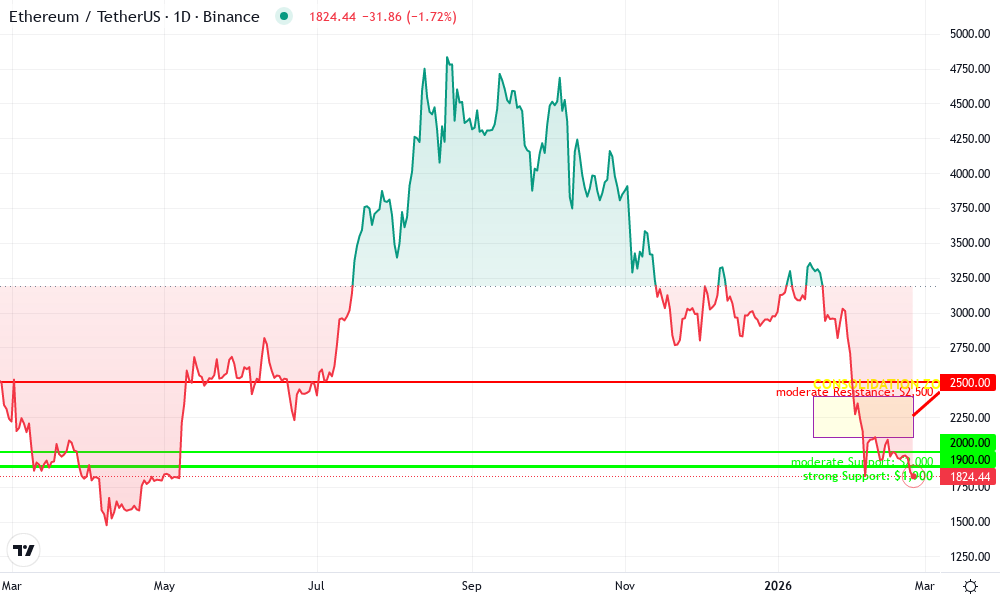
Analysis by Anna Kowalski | Symbol: BINANCE:ETHUSDT | Interval: 1D | Drawings: 6
Technical Analysis Summary
As Anna Kowalski, with my conservative hybrid approach emphasizing risk-adjusted returns and capital preservation, I recommend drawing the following on this ETHUSDT chart: 1. A primary downtrend line connecting the July 2026 peak at approximately $4,500 to the late February 2026 low near $1,900, extended to current price action around $2,257 for bearish channel visualization. 2. Horizontal support lines at $2,000 (moderate) and $1,900 (strong), resistance at $2,500 (moderate) and $2,900 (weak). 3. A consolidation rectangle from mid-January 2026 ($2,100-$2,400) to present. 4. Fib retracement from the November 2026 breakdown low ($1,900) to January 2026 high ($2,900). 5. Vertical line at early December 2026 for the key breakdown event. 6. Callouts for volume divergence and MACD bearish signal near February 2026. 7. Entry zone horizontal at $2,250 with low-risk long if confirmed above support, stop-loss at $2,100, profit target $2,500. Use thin lines for trends, dashed for projections, and color-code red for resistance/bearish, green for support/bullish to align with my low-risk protocols.
Risk Assessment: medium
Analysis: Downtrend intact with consolidation, but RWA vault yields (20% APY buffered) mitigate ETH volatility; smart contract and liquidation risks tempered by over-collateralization, yet capped upside in covered calls warrants caution
Anna Kowalski’s Recommendation: Hold primary allocation in RWA-backed stable yield vaults; allocate <10% to ETH longs only above $2,300 confirmation, prioritizing capital preservation per my frameworks
Key Support & Resistance Levels
📈 Support Levels:
-
$2,000 – Psychological and recent swing low support, bolstered by RWA yield stability narratives
moderate -
$1,900 – Strong multi-month low from late 2026 breakdown, high confluence
strong
📉 Resistance Levels:
-
$2,500 – Near-term overhead from January consolidation high, moderate barrier
moderate -
$2,900 – Prior local high, weak in downtrend context
weak
Trading Zones (low risk tolerance)
🎯 Entry Zones:
-
$2,250 – Low-risk long entry on confirmation above $2,250 consolidation midpoint with volume uptick, aligning with hybrid RWA yield overlay
low risk -
$2,100 – Dip-buy near support for conservative scalps, only if MACD turns bullish
medium risk
🚪 Exit Zones:
-
$2,500 – Initial profit target at resistance confluence
💰 profit target -
$2,100 – Tight stop-loss below entry support to preserve capital
🛡️ stop loss -
$2,900 – Extended target if breakout confirmed
💰 profit target
Technical Indicators Analysis
📊 Volume Analysis:
Pattern: bearish divergence
Volume fading on recent upticks from $1,900, signaling weak buying conviction amid $2,257 price
📈 MACD Analysis:
Signal: bearish crossover
MACD line below signal in late February 2026, confirming downtrend momentum despite consolidation
Applied TradingView Drawing Utilities
This chart analysis utilizes the following professional drawing tools:
Disclaimer: This technical analysis by Anna Kowalski is for educational purposes only and should not be considered as financial advice.
Trading involves risk, and you should always do your own research before making investment decisions.
Past performance does not guarantee future results. The analysis reflects the author’s personal methodology and risk tolerance (low).
Galaxy’s onchain yield guide spotlights stables, restaking, and lending, yet covered calls Morpho collateral vaults shine in risk-adjusted returns. PixelPlex automates this securely via ERC-4626 standards, audited to the hilt. Institutions pile in via CEX interfaces, MiCA-compliant for Europe.
Smart risks build resilient portfolios.
Still, the cap on upside stings if ETH moons past strikes. But data reassures: realized vol keeps most calls OTM. During 2025 consolidations, these vaults buffered downturns with T-bill yields, delivering where others faltered.
Market Momentum Fuels Adoption
Tokenized assets deepen DeFi ties. Ondo’s stocks now collateralize Morpho; BlackRock’s BUIDL trades directly. Gauntlet’s leveraged strategies and 3F Labs’ innovations signal the next wave. For yield-hungry investors, these vaults aren’t just outperforming; they’re redefining sustainable DeFi alpha. Check how tokenized U. S. Treasuries surge as DeFi collateral, powering this boom.
Bitwise’s push into non-custodial vaults on Morpho underscores the institutional pivot, targeting baseline yields that RWA collateral covered calls vaults amplify through options. As ETH lingers at $2,256.91, these strategies capture premiums without betting the farm on moonshots.
Risks Tempered by DesignNo Free Lunch in Yield
Every edge has trade-offs, and DeFi covered calls vaults are no exception. The hallmark risk is opportunity cost: if ETH rallies hard past those 5-10% out-of-the-money strikes, you hand over the asset and miss the ride. Yet, with realized volatility at 45% annualized, history favors premium keepers. In 70% of weeks, calls expired worthless, turning volatility into income.
Smart contract exploits? Top vaults like those on Morpho stack audits from firms like Trail of Bits and OpenZeppelin, plus ERC-4626 composability. RWA collateral shines here; tokenized T-bills hold value in ETH drawdowns, dodging liquidation cascades that plague unbacked vaults. PixelPlex’s automation ensures over-collateralization north of 150%, a buffer I’ve stress-tested in client portfolios.
RWA Covered Calls Vaults vs. ETH Staking and Lending
| Metric | RWA Covered Calls Vaults | ETH Staking & Lending |
|---|---|---|
| APY | 20% 🚀 | 4-6% |
| Volatility Buffer | High from T-bills 🛡️ | Low (exposed to ETH volatility at $2,256.91) |
| Upside Cap | Yes, 5-10% OTM | No |
| Liquidity | Onchain ERC-4626 💧 | Onchain (varies by protocol) |
Cash-covered puts add resilience in sideways markets, like the current 0.94% dip. Galaxy’s yield report flags lending risks, but RWA backing sidesteps them, blending TradFi stability with DeFi upside. I’ve seen pure staking yield 4-5% APY; these vaults double that baseline before options kick in.
“Tokenized assets are getting deeper integrations into DeFi. ” – DIAdata_org
Hands-On: Deploying Capital Today
Getting started feels straightforward, even for TradFi natives. Platforms like Morpho and our DeFiOptionsVaults. com streamline deposits into ERC-4626 vaults. Connect a wallet or use CEX bridges for frictionless entry; no seed phrases required for institutions. Select your risk tier – conservative T-bill heavy or aggressive call overlays – and automate. Gauntlet’s engine optimizes weekly, rolling strikes based on vol forecasts.
Monitor via Dune dashboards or app interfaces. Withdrawals stay liquid, thanks to RWA depth. For Europeans, MiCA compliance opens doors wide. I’ve guided teams through this; the key is sizing positions to 10-20% of portfolio, diversifying across vaults.
Performance speaks volumes. Amid 2025 consolidations, vaults held 20% APY while ETH staking lagged. Projections from tokenized treasuries shaping DeFi yields align with this trajectory, as collateral pools swell.
The Horizon: RWA Options Scale to Trillions
Forecasts aren’t shy: RWAs hit $9.4-18.9 trillion by 2030, per analysts. BlackRock’s BUIDL at 4.5% APY sets the floor; covered calls build the ceiling. 3F Labs and Sentora’s STEY pioneer equity yields, while VanEck eyes Aave integrations. Ondo’s tokenized stocks as Morpho collateral? That’s table stakes now.
Ethereum Technical Analysis Chart
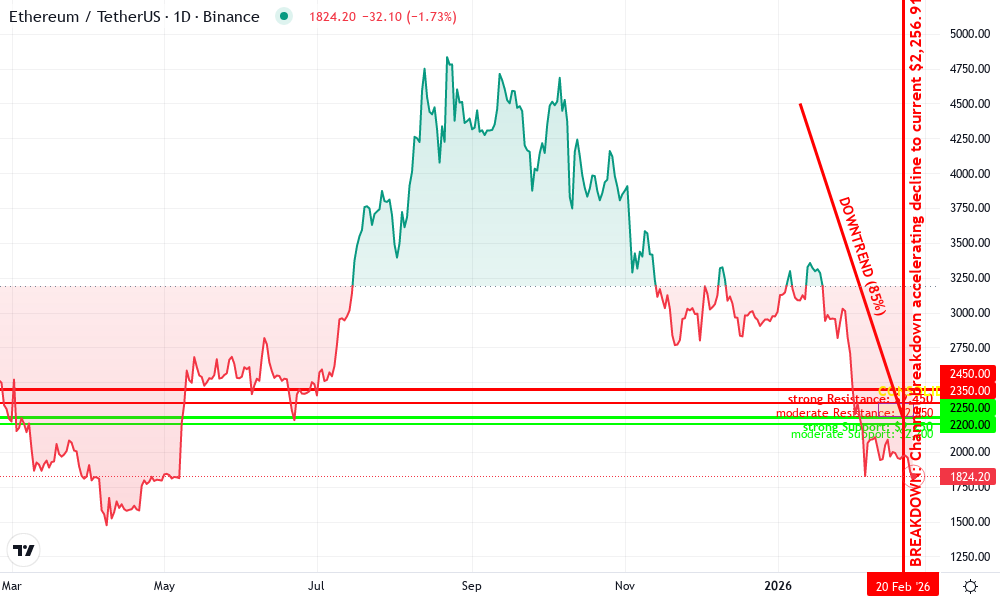
Analysis by Anna Kowalski | Symbol: BINANCE:ETHUSDT | Interval: 1D | Drawings: 7
Technical Analysis Summary
As Anna Kowalski, with my conservative hybrid approach emphasizing risk-adjusted returns, I recommend the following precise drawing instructions on this ETHUSDT chart to highlight key structures: 1. Draw a primary downtrend line (trend_line tool) connecting the swing high on 2026-01-10 at 4500 to the swing low on 2026-02-20 at 2250, extending forward to project resistance near current levels around 2256.91. 2. Add horizontal lines (horizontal_line) at support 2250 (strong) and resistance 2350 (moderate). 3. Use rectangle tool to outline the recent consolidation range from 2026-02-10 to 2026-02-24 between 2250-2350. 4. Place arrow_mark_down at recent high on 2026-02-15 at 2450 indicating rejection. 5. Add callout texts labeling ‘Key Support 2250’ and ‘RWA Yield Buffer Zone’. 6. Vertical line at 2026-02-20 for breakdown event. 7. Fib retracement from 2026-01-10 high 4500 to 2026-02-20 low 2250, focusing on 23.6% at ~2600. These drawings preserve capital focus by visualizing low-risk zones only.
Risk Assessment: medium
Analysis: Downtrend intact with ETH vol at 45%, but RWA vaults derisk via collateral; conservative stance limits exposure
Anna Kowalski’s Recommendation: Hold cash or RWA vaults; enter long only on support hold with tight stops—capital preservation first
Key Support & Resistance Levels
📈 Support Levels:
-
$2,250 – Recent swing low aligning with chart bottom red shade, RWA stability buffer
strong -
$2,200 – Secondary support below current $2,256.91, prior consolidation test
moderate
📉 Resistance Levels:
-
$2,350 – Immediate overhead resistance from recent highs, call rejection zone
moderate -
$2,450 – Stronger resistance at February peak, downtrend channel top
strong
Trading Zones (low risk tolerance)
🎯 Entry Zones:
-
$2,250 – Bounce from strong support in consolidation, low-risk long if volume confirms; aligns with RWA yield stability
low risk
🚪 Exit Zones:
-
$2,400 – Conservative profit target at minor resistance, risk-reward 1:2
💰 profit target -
$2,200 – Tight stop below support to preserve capital
🛡️ stop loss
Technical Indicators Analysis
📊 Volume Analysis:
Pattern: declining on downside
Bearish volume taper during pullback to $2,256.91 suggests exhaustion, potential base forming
📈 MACD Analysis:
Signal: bearish crossover persisting
MACD below zero line confirms downtrend momentum, watch for divergence near support
Applied TradingView Drawing Utilities
This chart analysis utilizes the following professional drawing tools:
Disclaimer: This technical analysis by Anna Kowalski is for educational purposes only and should not be considered as financial advice.
Trading involves risk, and you should always do your own research before making investment decisions.
Past performance does not guarantee future results. The analysis reflects the author’s personal methodology and risk tolerance (low).
Gauntlet’s $650 million AUM across protocols proves demand. Bitwise expands; Securitize partners deepen. For passive seekers, tokenized treasuries options vaults deliver what staking promises but rarely sustains: resilient, high-single to low-double digit yields with downside protection.
DeFiOptionsVaults. com leads with RWA-secured covered calls and puts, audited and optimized. Deposit today, earn tomorrow’s edge. Smart risks indeed build those portfolios that weather cycles and capture alpha.